

january reviewed
marty supreme, people we meet on vacation, the star wars prequel trilogy, and frankenstein (2025)

I’ve been watching a lot of movies lately and having a lot of thoughts about them, so here are my informal reviews of every film I watched in January! Expect a monthly reviewed post in your inbox on the final Friday of every month from here on out!
marty supreme
I think I am the only person on earth who missed all of the insane marketing for this film, honestly what pushed me to finally go see it was the critics choice controversy about Timothée Chalamet winning best actor over Michael B. Jordan (mind you I have not seen Sinners yet). I digress, onto my review.
Timothée Chalamet delivers a stellar performance to be sure, and so does Odessa A’zion, whose character I enjoyed the most. Chalamet portrays Marty with an honesty that is hard to tear your eyes away from, while you never feel as though you’re being induced to liking Marty as a person, you can’t help but root for him. His character arc was compelling and layered, though I do feel that the Tears for Fears song in the final scene was doing a good bit of emotional heavy lifting.
The overall problem with this film for me is that the “egotistical man who will stop at nothing to achieve his dreams” narrative is played out. While a stellar version of this story, Marty Supreme does nothing particularly special or unique with it. I think the film nails its beats and is worth being 2.5 hours long (which is something I rarely say about long Hollywood films), but at the end of the day is mostly unimaginative. A film like Channing Tatum’s Roofman (2025) is in my eyes more deserving of critical acclaim over Marty Supreme, especially if we’re talking about these films as biopics.
Where I think the film was doing some interesting work was in the characters of Rachel and Kay, they weren’t just the female side characters used as narrative devices to make us feel for Marty or help Marty on his character journey. They both felt fully realised, and the film utilised their characters to flesh out its themes of ambition and surrender.
I struggle to discuss the Kevin O’Leary of it all, because despite delivering a shockingly compelling performance (though I am sort of convinced he was just playing himself) I don’t want to see that man anywhere near the arts, thank you very much.
At the end of the day, I think that Marty Supreme was a technically brilliant, but a thematically forgettable film.
people we meet on vacation
This is actually the only Emily Henry novel I have read, and so I was very excited about this adaptation. I read the novel in 2022 at a particularly apt time in my life, so I have a deep love for this story and its characters. I could see myself filling in gaps from the movie with things I know to be canon in the books, which makes it difficult to separate the viewing and reading experience of the story a little.
Not to be a book purist, but I did generally feel that the things changed from the book to film were the weakest aspects, specifically because they didn’t feel as though they were changed with intention. For example, things like Poppy meeting Alex’s dad at the wedding and Poppy meeting Sarah for the first time in Italy both felt like confusing and uncharacteristic changes to this story that were made in order to save time in the film.
More importantly to me was that the film’s sense of place was sorely missing—which is especially egregious in a film centred around travel. The change of location from Palm Springs to Barcelona was clearly borne out of the inability to foot the bill to film in Palm Springs, and then there was no effort put into making Barcelona feel significant as the new location choice. Not to mention filming the final Linfield Ohio scene in what was so clearly New Orleans!
Still, this film just had that intangible something that a good rom-com has, that perfect mix of giddiness and earnestness and hopefulness. Poppy and Alex performing Forever Your Girl was literally life altering. Emily Bader needs to lead every rom-com ever because she was ridiculously ethereal and gorgeous the whole time, and exactly how I imagined Poppy. Tom Blythe was robbed by the script a little (they cut so many of his yearn-a-tron-3000 moments), but still played Alex, a semi-awkward, semi-repressed character, with phenomenal emotional depth1.
I will close this out with my hot take that is especially relevant to this film: rom-coms should either be a tight 90 minutes, or be a full three hours with a solid two act structure and even a Bollywood style intermission. I think a story like this needed to be an extra 30 minutes long in order to hit its emotional beats—Poppy and Alex’s initial falling out, Alex’s attachment to Linfield Ohio, and Poppy’s relationship with Alex’s family and her own family being particularly important ones.
star wars - the prequel trilogy
At the tail end of 2025 Boy showed me the original Star Wars trilogy, and this month we made our way through the prequel trilogy, which is getting its own condensed review here. I understand that culturally the prequels are considered to be of lower quality than the originals, and that Hayden Christensen is considered to be a pretty bad actor, but honestly I prefer these films to the original trilogy in terms of plot intrigue, world building, and overall rewatch-ability.
I found these films to be innovative, delightfully space politics heavy, and full of stranger characters.
I don’t have anything clever to say about these films outside from telling you I enjoyed them so I will leave you with a list of my most important thoughts:
My love of Jar Jar Binks: what a strange little guy, obsessed with how central of a character he is throughout.
Why is Nute Gunray Chinese????
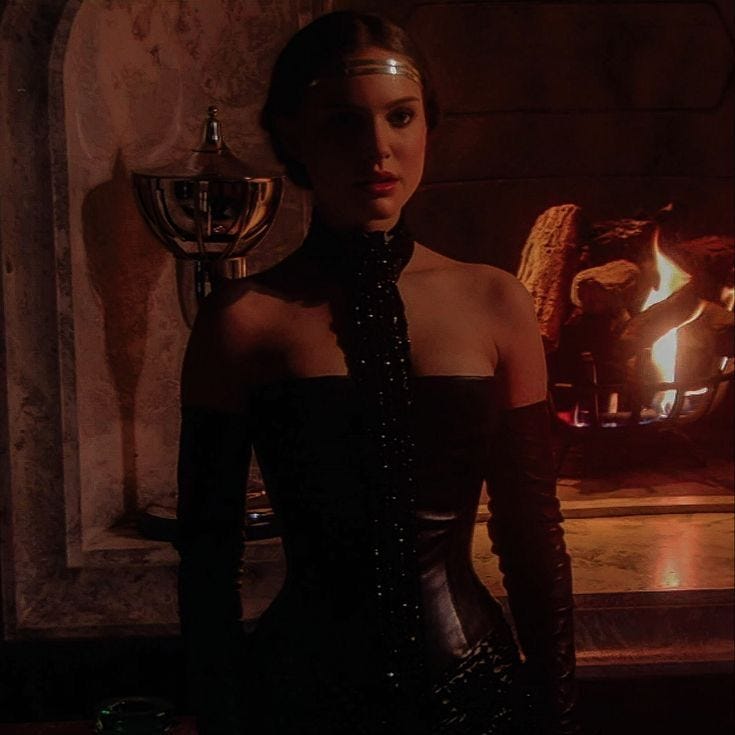
Why in Episode II does Padme inexplicably have an insanely cunty dominatrix outfit, and where do I buy it?
Obi-Wan’s bird-dog-lizard creature in Episode III, love that creature and love that he chose an incredibly loud and conspicuous mode of transportation at a time where he really desperately needed to be sneaky.
frankenstein (2025)
Frankenstein was almost phenomenal. The film was visually delightful and grotesque, had a gorgeous theatricality to it, and though diverged significantly from the nuts and bolts of the novel, suggested at times a deeply compelling modernisation of Shelley’s original story.
There were things I loved about this film on a textual level; the choice to center Elizabeth in the narrative, moving the action to the 1850’s, and the new creation myth of the monster. Yet, despite coming away initially rather enthralled, I feel that overall this version of Frankenstein was telling a very different story.
I am not a purist when it comes to adaptations, and though I may feel that some of the themes this film decided to use Frankenstein as a vessel for were not what I would have imagined—namely, exploring the hope that love can liberate us from toxic cycles of violence—really my issue is that Del Toro clearly wanted to do it all with this adaptation, which results in a film that feels thematically bloated and contradictory.
The triumph of this film was the way it brought the novel’s themes of hubris, advancement, and ethics into a 21st century context: focusing less on individual ambition and corruption, but instead the cultural and systemic desire for advancement with no thought for consequences; ideas about men’s inability to create life and therefore their desire to conquer (or replicate) it instead; and ideas of not just identity, but memory.
But this in combination with the heavy handed religious imagery, the victimisation of the monster, and the pathologizing of Victor though a tragic back story resulted in a film that betrayed its central theme of hubris and monstrosity. Specifically on the allegorical level of the monster as technology and artificial intelligence, the theme of forgiveness felt sorely out of place and indulgent.
Shelley’s novel is philosophical and morally ambiguous. I don’t think it's a crime to take the bones of her story and moralise it, but I do think it's frustrating to see a film that fumbles its own ideas.
Overall, though I enjoyed this film a lot, I wasn’t convinced by Del Toro’s case for a reading of Frankenstein as a story about trauma and forgiveness rather than of monstrosity, isolation, and ambition. I am compelled by it on a cinematic level and on a discursive level (famously, I love anything that complicates the narrative), but overall, this adaptation doesn’t hold a candle to the book.
ta da!
Namely the vasectomy plot point in the novel, which while a little insane is so essential to the kind of man Alex is.